
What “Tight Tolerance” Really Means — And Why Your Parts Depend on It
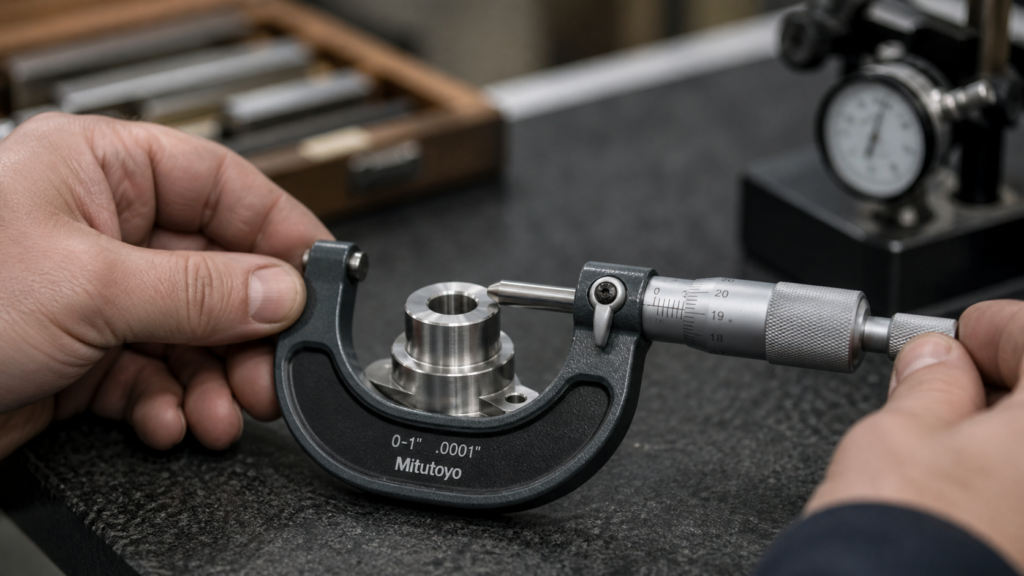
Precision machinists throw around the phrase “tight tolerance” like everyone knows what it means. Most customers do — in a general sense. But when a project goes sideways because a part came back at ±0.003” instead of ±0.0005”, the difference stops being abstract.
Here’s a plain-language look at what tolerance means in precision machining, how tight is actually tight, and why the entire system around the machine — inspection, fixturing, environment, people — matters just as much as the equipment itself.
The Basics: What Tolerance Means
Tolerance is the allowable variation from a specified dimension. If a print calls for a pin diameter of 0.5000” with a tolerance of ±0.0005”, the finished part must measure between 0.4995” and 0.5005”. Anything outside that range is a reject.
For reference, a human hair is roughly 0.003” in diameter. A tolerance of ±0.0005” is six times smaller than that. At that scale, temperature changes in the shop, the condition of a cutting tool, and the rigidity of a fixture all become variables that affect whether a part passes inspection.
This is why “we have CNC machines” is not the same as “we hold tight tolerances.”
Where Tight Tolerance Work Actually Lives
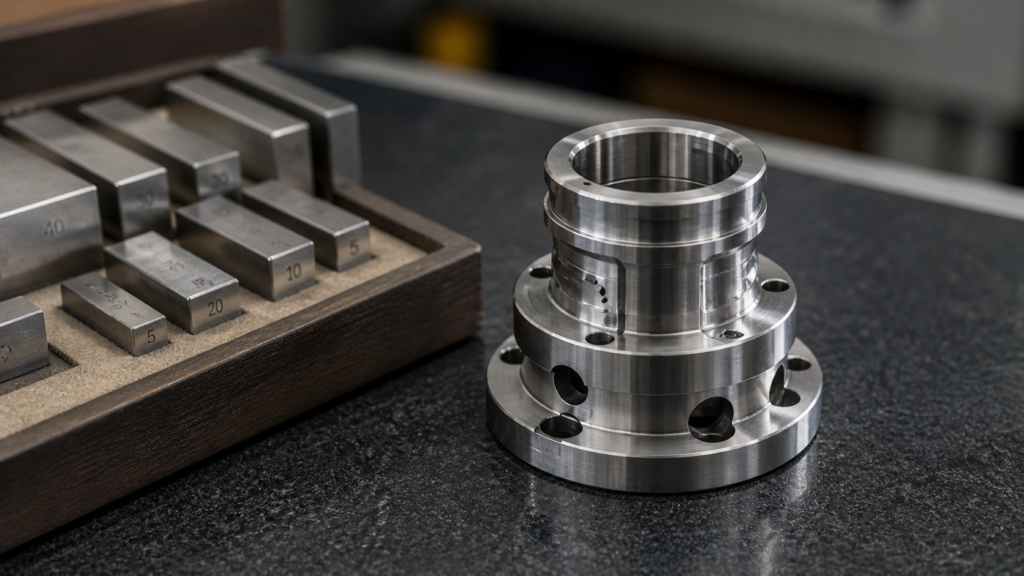
Not every part needs ±0.0005”. General machining — brackets, enclosures, structural components — often tolerates ±0.005” or more. Tight tolerance work tends to show up in industries where fit, function, and safety are inseparable:
- Aerospace and defense, where components must perform reliably under extreme conditions
- Medical devices and instruments, where dimensional accuracy directly affects patient outcomes
- High-performance tooling and fixtures, where a worn or off-spec component degrades everything downstream
- Fiber-optic and photonics components, where alignment tolerances are measured in microns
What these applications share: the tolerance isn’t a specification someone added to be cautious. It’s a functional requirement. The part either fits and works, or it doesn’t.
The System Behind the Spec
At Objective Industries, we’ve been running tight-tolerance work since 1967. In that time, one thing has stayed constant: the machine is only part of the story.
Holding ±0.0005” across a production run requires the whole system to perform:
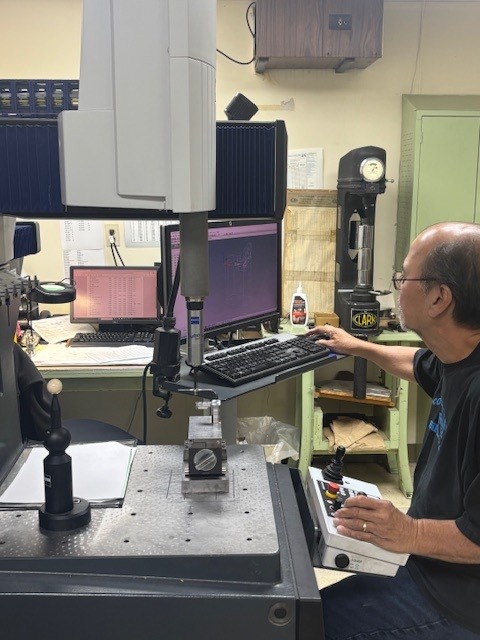
- Inspection that’s built in, not bolted on. Our QC department uses a Zeiss DuraMax CMM, optical comparators, surface profile gages, and calibrated gage block sets traceable to NIST standards. Parts get verified — not assumed.
- Grinding capability that goes where milling stops. Our surface and cylindrical grinders achieve surface finishes and dimensional tolerances that CNC milling alone can’t reach. The Blohm grinders with .000050” DRO resolution are a good example of why equipment spec sheets matter.
- EDM for geometries that cutting tools can’t produce. Wire EDM is non-contact — there’s no cutting force to deflect a thin wall or distort a delicate feature. When a feature simply can’t be reached any other way, EDM is often the answer.
- Material knowledge. Metals, ceramics, plastics, and tungsten carbide don’t machine the same way. Each has its own behavior under heat, tool pressure, and vibration. Experience with the material matters as much as the machine doing the cutting.
- People who have done it before. Our apprentice program has been feeding skilled machinists into the shop for years. Tight-tolerance work gets easier when the person at the machine has run it a thousand times.
ISO 9001:2015 and What It Actually Means for Your Parts
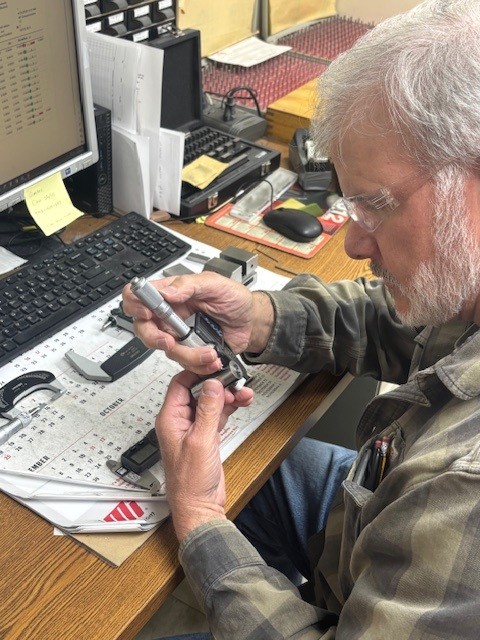
Objective Industries is ISO 9001:2015 certified. For customers, this matters for a specific reason: it means our quality management system has been audited against an internationally recognized standard. Documented processes, calibration records, corrective action protocols — all of it is in place and verified.
In plain terms: we can show our work, and an independent third party has confirmed we’re doing it consistently.
Bringing Tight-Tolerance Work to Us
If you’re sourcing precision machined components — especially in aerospace, defense, medical, or high-precision instrumentation — the conversation usually starts with a print and a question: “Can you hold this?”
At Objective, we’d rather answer that question with specifics than reassurances. Send us your specs. We’ll tell you exactly where your tolerances land relative to our capabilities — and if a feature pushes into EDM or grinding territory instead of straight CNC, we’ll say so.
Objective Industries | 134 Expo Rd, Fishersville, VA | (540) 337-4800 | Info@Objectiveind.com